Agent4Target: An Agent-based Evidence Aggregation Toolkit for Therapeutic Target Identification
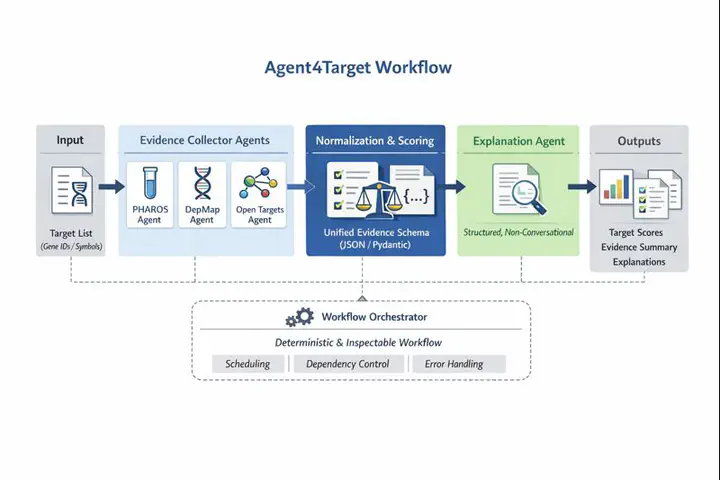
- Topics: therapeutic target identification, drug discovery, evidence aggregation, AI agents, biomedical knowledge integration
- Skills:
- Programming Languages: Python; experience with modern ML tooling preferred
- Machine Learning / AI: agent-based systems, workflow orchestration, weak supervision (basic), representation learning
- Software Engineering: modular system design, APIs, CLI tools, documentation
- Biomedical Knowledge (preferred): familiarity with drug–target databases (e.g., PHAROS, DepMap, Open Targets)
- Difficulty: Advanced
- Size: Large (350 hours)
- Mentors: Ziheng Duan (contact person)
Project Idea Description
Identifying and prioritizing high-quality therapeutic targets is a foundational yet challenging task in drug discovery. Modern target identification relies on aggregating heterogeneous evidence from multiple sources, including genetic perturbation screens, disease associations, chemical biology, and biomedical literature. These evidence sources are highly fragmented, noisy, and heterogeneous in both format and reliability.
While large language models and AI agents have recently shown promise in automating scientific workflows, many existing approaches focus on end-to-end prediction or conversational interfaces. Such systems are often difficult to reproduce, extend, or integrate into existing research pipelines, limiting their practical adoption by the biomedical community.
This project proposes Agent4Target, an agent-based evidence aggregation toolkit that reframes therapeutic target identification as a structured, modular workflow. Instead of using agents for free-form reasoning, Agent4Target employs agents as orchestrated components that systematically collect, normalize, score, and explain evidence supporting candidate therapeutic targets.
The goal is to deliver a reusable, open-source toolchain that can be integrated into diverse drug discovery workflows, independent of any single downstream prediction model or publication.
Key Idea and Technical Approach
Agent4Target models target identification as a multi-stage, agent-driven pipeline, coordinated by a central orchestrator:
Evidence Collector Agents
Specialized agents retrieve target-level evidence from heterogeneous sources, such as:- Genetic perturbation and dependency data (e.g., DepMap)
- Target annotation and development status (e.g., PHAROS)
- Disease association scores (e.g., Open Targets)
- Automatically summarized literature evidence
Normalization & Scoring Agent
Collected evidence is converted into a unified, structured schema using typed data models (e.g., JSON / Pydantic).
This agent performs:- Evidence normalization across sources
- Confidence-aware scoring and aggregation
- Optional weighting or calibration strategies
Explanation Agent
Rather than free-text generation, this agent produces structured explanations that explicitly link scores to supporting evidence, enabling transparency and interpretability for downstream users.Workflow Orchestrator
A lightweight orchestration layer (e.g., LangGraph or a state-machine-based controller) manages agent execution, dependencies, and failure handling, ensuring reproducibility and extensibility.
This modular design allows individual agents to be replaced, extended, or reused without altering the overall system.
Project Objectives
- Design a Modular Agent-based Architecture
- Define clear interfaces for evidence collection, normalization, scoring, and explanation agents.
- Implement a Standardized Evidence Schema
- Develop a unified data model for heterogeneous target-level evidence.
- Build a Reproducible Orchestration Framework
- Implement a deterministic, inspectable workflow for agent coordination.
- Deliver a Community-Ready Toolkit
- Provide CLI tools, example notebooks, and clear documentation to support adoption.
- Benchmark and Case Studies
- Demonstrate the toolkit on representative target identification scenarios using public datasets.
Project Deliverables
- Open-Source Agent4Target Codebase
- A well-documented Python package with modular agent components.
- Command-Line Interface (CLI)
- Tools for running end-to-end evidence aggregation pipelines.
- Standardized Output Schema
- Machine-readable evidence summaries suitable for downstream modeling.
- Example Notebooks and Benchmarks
- Demonstrations of usage and performance on real-world target identification tasks.
- Documentation
- Installation guides, extension tutorials, and developer documentation.
Impact
Agent4Target provides a practical bridge between AI agents and real-world drug discovery workflows. By emphasizing structured evidence aggregation, reproducibility, and interpretability, this project enables researchers to systematically reason about therapeutic targets rather than relying on opaque, end-to-end models. The resulting toolkit can serve as a foundation for future work in AI-assisted drug discovery, weak supervision, and biomedical knowledge integration.

Ziheng Duan
Postdoctoral Researcher, University of California, Irvine
I develop trustworthy machine learning methods for single-cell and spatial genomics, with applications to disease understanding and drug discovery.